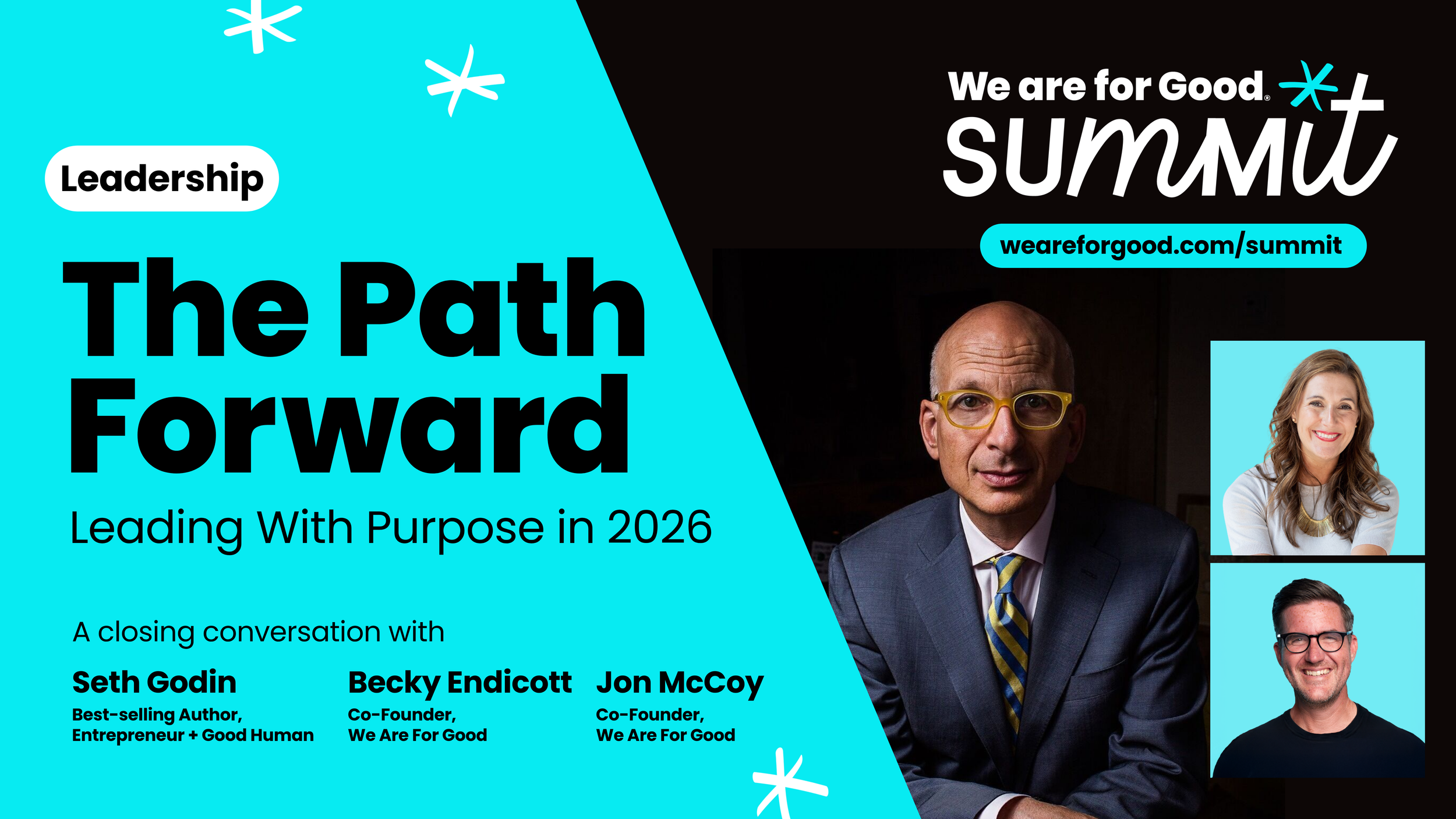
Seth Godin's Advice for Nonprofit Professionals Feeling the Weight of Uncertainty
If you've ever felt the tension of doing deeply meaningful work while wondering if it's ever going to be enough, this conversation is for you.
At the We Are For Good Summit, we closed out a full day of powerful sessions with a grounding, honest, and deeply human conversation with Seth Godin. And we haven't stopped thinking about it since.
Seth is a bestselling author, a lifelong champion of nonprofit work, and someone who grew up watching his parents live this mission. His mother was the first woman on the board of what is now the Albright Knox Art Gallery in Buffalo. His father led the United Way as a volunteer. For Seth, this isn't theory. This is home.
What followed was one of the most honest conversations we've had on stage. We talked about uncertainty, burnout, trust, AI, and the kind of courage our missions are calling us toward right now.
Here are the moments we can't stop thinking about.
"This Is as Normal as It's Ever Going to Be Again."
We opened by asking Seth about something he's said before that stopped us cold: that uncertainty isn't a season we're passing through. It is the environment now.
His response? A gentle, clarifying reframe.
"We are for good," he said. "Notice it doesn't include any of the other parts. Because if the other parts came with it, there wouldn't be a good shortage. What creates the good shortage is that it comes with imperfect, it comes with uncertain, it comes with things that don't work."
You can't run a marathon without getting tired. You can't do good work without dancing with all the messy parts that come with it.
That's not a consolation prize. That's the deal.
The Real Reason We Burn Out
This one landed hard in the room.
Seth introduced the idea of attachment. Not in a detached, clinical way, but with the warmth of someone who genuinely gets it. When our work is meaningful, we attach ourselves to outcomes. And when those outcomes don't materialize the way we hoped, it doesn't just sting. It depletes us.
"All burnout is a symptom of stress. Stress is wanting two things at the same time, to flee and to stay. If you're getting burned out, it's probably because you're attached."
He offered the image of an emergency room doctor. How do they keep going, shift after shift, loss after loss? They are fully, completely present when the patient is in the room. And when the patient leaves, they leave too. Not because they don't care. Because being present is the care.
"Here, I made this." The keyword isn't "I." It's "this."
Do the work. Release the outcome. Show up again tomorrow.
Trust Is the Work Now
We've been saying this at We Are For Good all year: trust is the defining challenge of this moment. Every one of us has been let down by an institution we believed in.
So how do leaders rebuild it?
Seth's answer was simple and unsparing: new behavior, done consistently.
"The way we rebuild trust is by reliably making promises and keeping them. And that can include, 'I am promising to do my best, and it might not work.' That's still a promise."
He told the story of a city library that sent a deceptive fundraising email to 10,000 people, disguised as a personal note, designed to trigger urgency. They raised some money. And they burned down a hundred years of trust to do it.
Consistency isn't a strategy. It's a covenant. Every time you show up the way people expect you to (with honesty, with clarity, with the same values you had yesterday), you make a small deposit. Every time you don't, you make a large withdrawal.
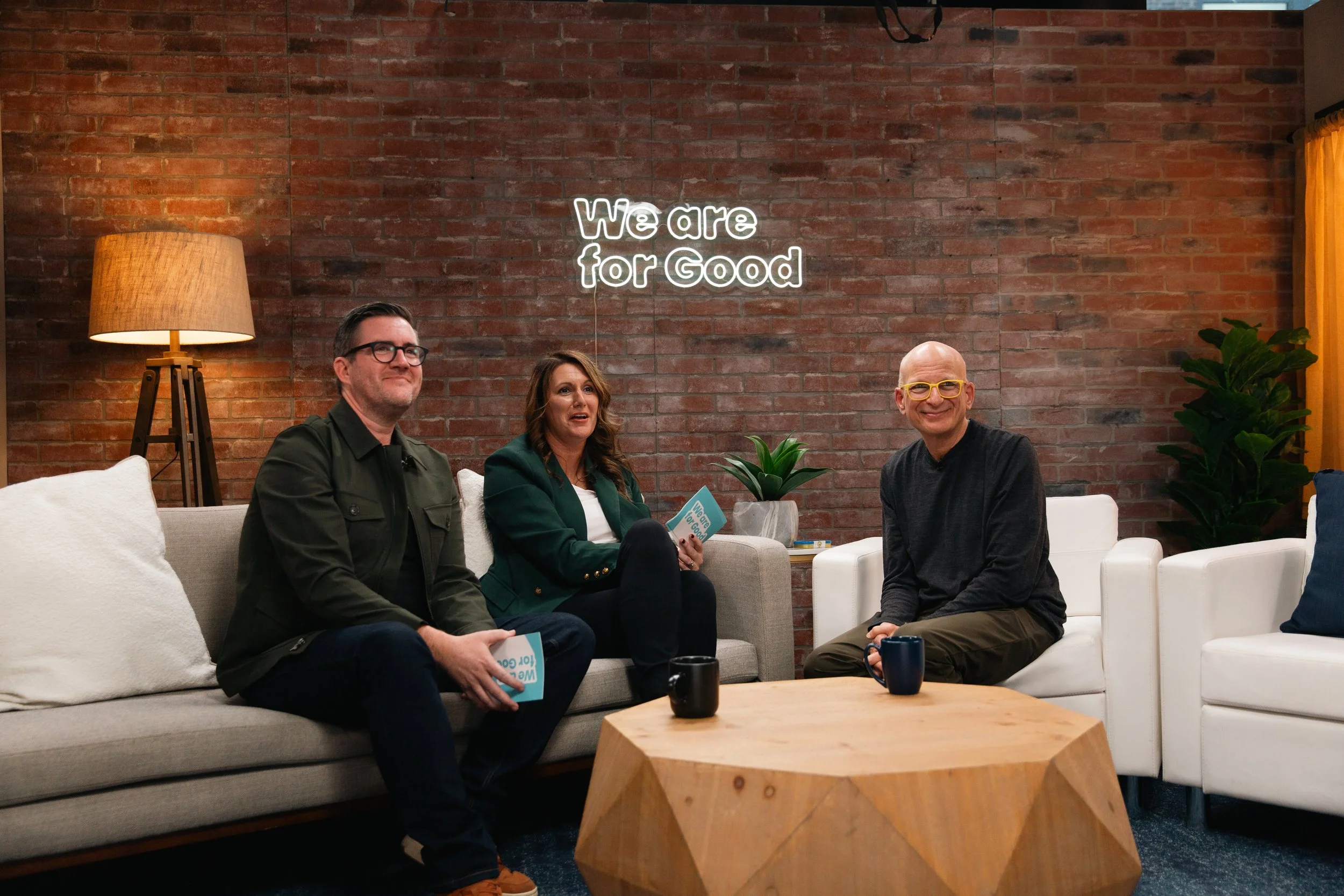
Jon McCoy + Becky Endicott, Co-Founders, We Are For Good with Seth Godin
We Don't Have Trouble With Risk. We Have Trouble With the Feeling of Risk.
"It might feel risky to go forward with a new program. But in fact, if you don't, you're taking a much bigger risk, because you're probably going to have to shut down over time because you didn't do anything important."
AOL. Yahoo. GeoCities. They didn't disappear because they took too many risks. They disappeared because they spent all their energy avoiding the feeling of risk and missed doing anything that mattered.
We signed up for this. We signed up to feel the feeling of doing something risky in service of the missions we love. That's not a bug. That's the job description.
AI Isn't the Threat. Doing Tasks Instead of Making Decisions Is.
Seth's take on AI for nonprofits is clarifying and, honestly, a little freeing.
Every task in your organization should be automated as fast as possible. Not because people don't matter, but because your people weren't hired to do tasks. They were hired to make decisions.
"Either AI works for you, or you work for AI. You do not want to work for AI. It's a lousy boss."
The question to ask of every person on your team: are they outsourcing their tasks and making human decisions? Because that's what nonprofits need right now. Not more task completion. More decision-making. More judgment. More humanity.
The Lifeguard Story
We've heard a lot of Seth Godin over the years. This might be our favorite story he's ever told.
Forty years ago on Lake Michigan, a six-year-old named Robin wandered into the water and started to drown. A 19-year-old lifeguard on duty (not the best lifeguard in the world, maybe not even the best one on the beach that day) jumped in and saved him.
Nobody questioned her credentials. Nobody asked if there was someone more qualified nearby.
She was there. She jumped.
"You signed up to work at a nonprofit because you want to cure tuberculosis, or help people get access to the arts, or help people survive cancer. And no, that person is not drowning 10 feet in front of you. But it's the same thing."
You don't need permission. You don't need to stop feeling like an imposter — that feeling is a sign you care about quality. Feel the fear. Do it anyway.
There is someone drowning. And you are already there.
Watch the Full Conversation
This conversation went deep, and we only scratched the surface here.
Seth also talked about:
What nonprofits can learn from the history of art museums
How to communicate risk and experimentation to donors without sounding uncertain
Why agency is the most important thing you can offer people in the age of AI
His beautiful, simple answer to what gives him hope
[button to membership.io] so they have to put their email in