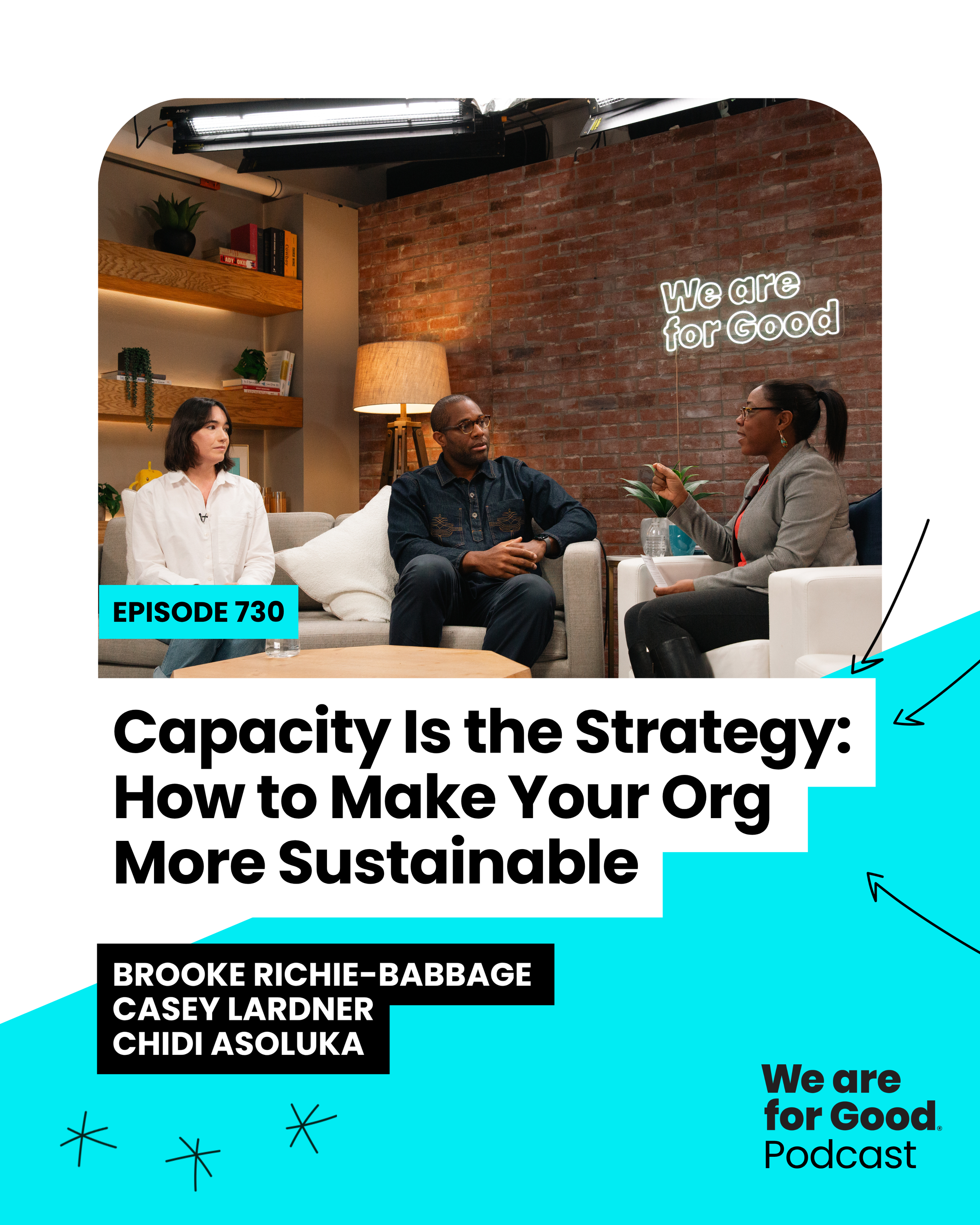
730. Capacity Is the Strategy: How to Make Your Org More Sustainable - Brooke Richie-Babbage, Chidi Asoluka, and Casey Lardner
Listen to this episode
About This Episode
Most nonprofit leaders are carrying ambitious visions inside organizations that were never designed to hold that much weight. Brooke Richie-Babbage's reframe: capacity isn't a resource you deplete, it's a structure you build — and the strain is information about that structure.
She's joined by two leaders she's worked with closely. Casey Lardner runs Genspace, the world's first community biology lab. Chidi Asoluka founded NewComm, which grew from 18 kids in a classroom to delivering projects for the NYC Department of Health and Mount Sinai.
Both get specific about what made their orgs sustainable: naming what they're not, defining who owns what, agreeing on what success looks like before decisions get made, and building systems that run without the founder in the room.
In this episode, you'll hear:
Why sustainability starts with clarity — you can't design the right systems until you know what you're running toward
The mindset shift from vision holder to architect of systems, and how Chidi stopped being the bottleneck in his own org
How Casey unlearned "strain equals effort" and started treating burnout as a diagnosable syndrome, not a cost of doing business
The roles-and-responsibilities work that has to land before shared decision-making or partnerships can actually lighten your load
What frees up when operational work leaves the founder's plate: time in the field, time to think, time to dream
You'll walk away with a practical way to read your own strain as data — and a starting point for building an org that keeps running when you step back. 🩵
Episode Highlights:
(1:18) Meet Casey and Chidi and their missions
(3:22) The founder bottleneck
(6:19) Unlearning hustle-as-virtue in a growing org
(8:09) "It's too soon to panic"
(9:41) From teacher to architect: building repeatable systems
(11:52) Clarity first: defining who you're not
(14:54) Roles, ownership, and Invitation Power
(17:34) What sustainability actually feels like day to day
(21:20) Where to stop pushing and start redesigning
(22:09) Live the lesson
Brooke Richie-Babbage: The Strategist Who Treats Burnout as a Design Problem
Brooke Richie-Babbage coaches nonprofit leaders through the stage where ambition outpaces infrastructure. Her argument: burnout and bottlenecks are signals about organizational design, not personal failings.
Meet Casey and Chidi: Two Leaders Designing for Sustainability
Casey Lardner is the executive director of Genspace, the world's first community biology lab, in South Brooklyn. She came to nonprofit leadership from academic neuroscience, where strain was treated as proof of effort — and she's a competitive runner, so "push harder" was double-baked in. Unlearning it is a through-line here.
Chidi Asoluka is the founder and CEO of NewComm, a student-led community that delivers projects for clients such as the NYC Department of Health and Mount Sinai. He describes his own shift plainly: from the teacher at the center of the room to an architect of systems.
Powerful Quotes
"That strain is actually information. It's telling us something about the design of the organization, not the dedication of the people inside it." — Brooke
"You can't set up the right systems if you aren't clear what you're running towards." — Brooke
"When you set up the bones, people can breathe life into them with you." — Brooke
"I became the bottleneck because people were waiting to see if the person with the dream actually believes in the thing that they're doing." — Chidi
"The difference between an educator and an operator is being clear on who we are and also who we are not." — Chidi
"You must live the lesson. You must live the class as if you are the student." — Chidi
"It's too soon to panic. It's always too soon to panic." — Casey, quoting an early-career mentor
"There's this culture in research that is also true for nonprofits, where if you're not working hard, you're not doing it right." — Casey
"Burnout is a syndrome that has symptoms that you can pick on and pull apart and fix." — Casey
"We can incubate biotech companies and early stage founders, but we are not an incubator. So what does that mean for us and our systems if that's true?" — Casey
"When you give ownership of part of a larger mechanism, people are really excited because they know the boundaries of this responsibility." — Chidi
Resources Mentioned
Genspace: the world's first community biology lab, offering hands-on access to biotechnology tools in South Brooklyn
NewComm: high school student-led community designing and executing projects for local clients
Next Level Nonprofit: Brooke's mastermind program, which Casey credits with helping her learn to read strain as a signal
MOCHA framework: a roles-and-responsibilities tool Casey's team uses to clarify who owns, decides, and needs to be informed
Come join us in the We Are For Good Community!
Join fellow changemakers, share takeaways from this episode, and keep collaborating in a space built for connection, inspiration, and real impact: www.weareforgoodcommunity.com
Say hi👇
LinkedIn / Instagram / Facebook / YouTube